
In October 2026 the UK’s Department for Science, Innovation and Technology (DSIT) awarded £900,000 for a single online platform to help “upskill 10 million UK workers in AI skills by 2030”. In August 2025, Poland’s national research network NASK opened a framework for 12,000 AI lab kits for the country’s primary and secondary schools. Neither buyer is a school, and neither is buying an AI tutor. Governments and their agencies do most of the buying, and most of what they buy is training that teaches people to use AI.
That is the pattern across the UK and Europe. We searched every public procurement notice published from January 2023 to 20 October 2026 for AI in education and training, and found 390 purchases from 25 countries.
What the tenders show, in five points.
- Ministries, councils and agencies buy. Schools rarely do. Central government ran 124 of the 390 procurements. Individual schools, school trusts and colleges ran 11.
- Six in ten buy training about AI. About one in seven buys an AI tutor or learning platform.
- When governments want an AI learning tool built, they commission it centrally. England’s Department for Education (DfE) and DSIT, France’s Caisse des Dépôts and the EU’s maritime safety agency all ran development contracts for AI tutoring or training tools.
- UK buying has risen every year. It went from 16 procurements in 2023 to 97 by 20 October 2026. Europe grew fast to 2025 and then levelled off.
- UK contracts are small and rarely go to open tender. A typical UK contract is about £90,000, against about €390,000 in the EU, and only one UK purchase in six was an open tender.
All 390 procurements are in our free AI in Education Tender Explorer, where you can search, filter and download them with a link to every official notice. Each finding below ends with a line in italics on how far the evidence goes.
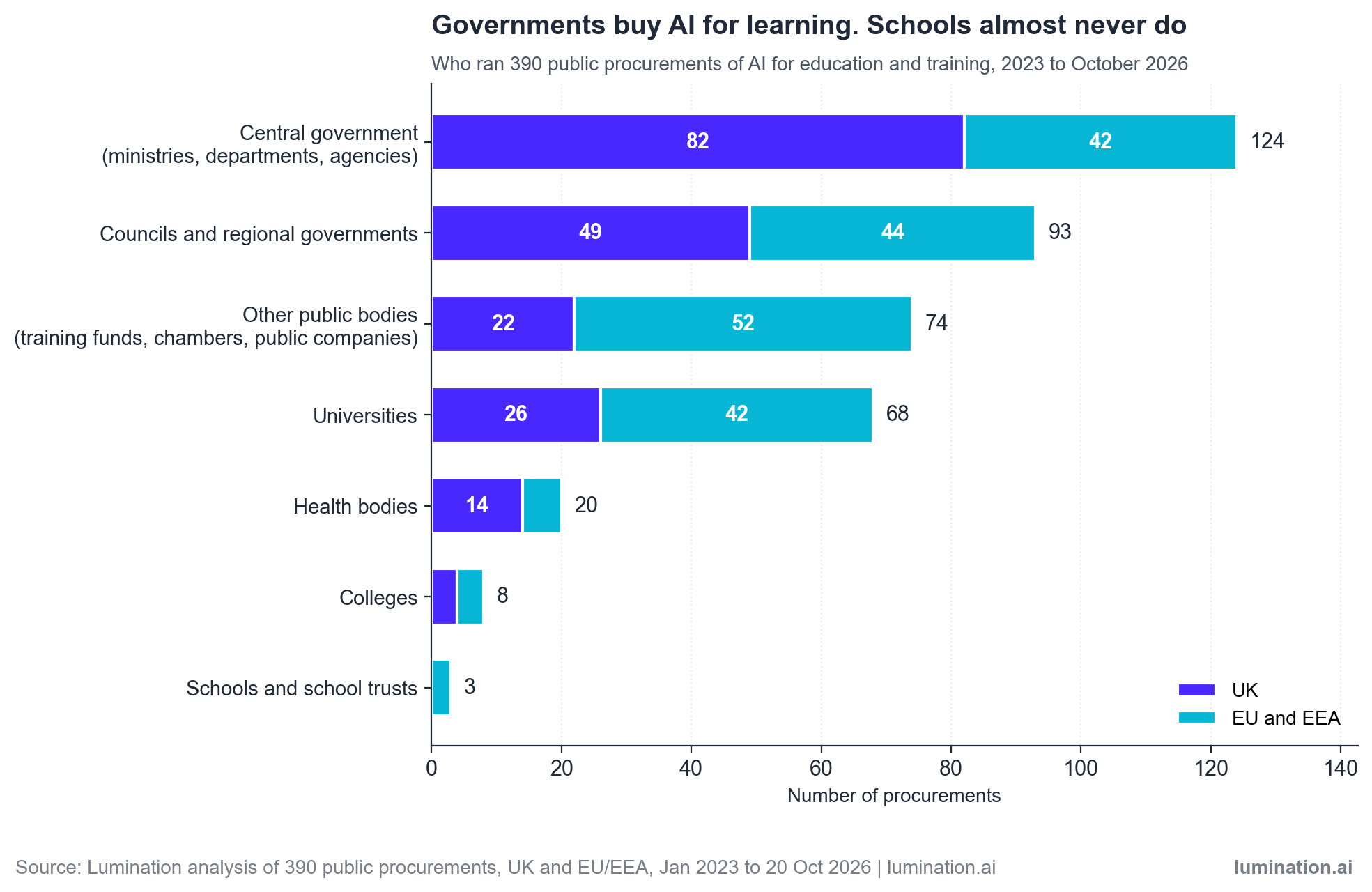
1. Ministries and councils do the buying. Schools rarely do
Central government is the largest buyer, with 124 procurements. Councils and regional governments follow with 93, then other public bodies with 74 (France’s sector training funds, Ireland’s Skillnets, chambers of commerce, EU agencies, public companies) and universities with 68. Health bodies ran 20. In the UK, central government alone accounts for 82 of 197 procurements, led by the DfE, DSIT and the Department for Work and Pensions.
AI for schools is mostly decided and paid for above the school.
- England. The DfE ran an AI Tools for Education competition with Innovate UK for generative AI tools that help teachers assess pupils’ progress and give feedback. It bought a £3m machine-readable content store after its own hackathons found that standard language models “weren’t ready for use in schools”. It also paid for safe-use training and toolkits for teachers and school leaders (2024 and 2025) and a digital, data and AI skills pathway for the school workforce (£300,000, 2026).
- Poland. The AI lab framework covers 12,000 kits, 8,000 for primary schools and 4,000 for secondary schools, and was awarded to six suppliers in early 2026.
- Greece. The education ministry’s digital school programme, awarded for €57.6m in 2025, includes AI tools and adaptive content for pupils and teachers.
- France. The Caisse des Dépôts ran an innovation partnership (a contract that pays for research and development, then buys the result), estimated at €13.3m, for an AI teaching assistant for teachers and pupils aged about 9 to 11, in French, maths and modern languages.
Universities are the exception, because they buy for themselves. Their purchases include licences, learning platforms, AI teaching labs, staff training and student services. The University of Kent awarded about £3.3m to OpenAI for an enterprise generative AI platform for staff and students. The Bundeswehr University Munich and Tallinn University of Technology bought ChatGPT Edu, and Portsmouth, Nottingham Trent and Keele bought AI chatbots and careers tools for students. Jisc, the UK’s digital agency for colleges and universities, buys for the whole sector, including a $7.56m time-limited evaluation of ChatGPT Edu and OpenAI’s enterprise tools in 2026.
Strong across countries. Purchases by single schools are often too small to need a public notice, so they are probably under-represented here.
2. Six in ten purchases teach people to use AI
Of the 390 procurements, 229 (59%) buy AI training or AI literacy. AI tutors and learning platforms make up 56 (14%), consultancy and research 35, and AI tool licences 22. The rest are AI teaching labs and equipment, admin and content tools, and student chatbots.
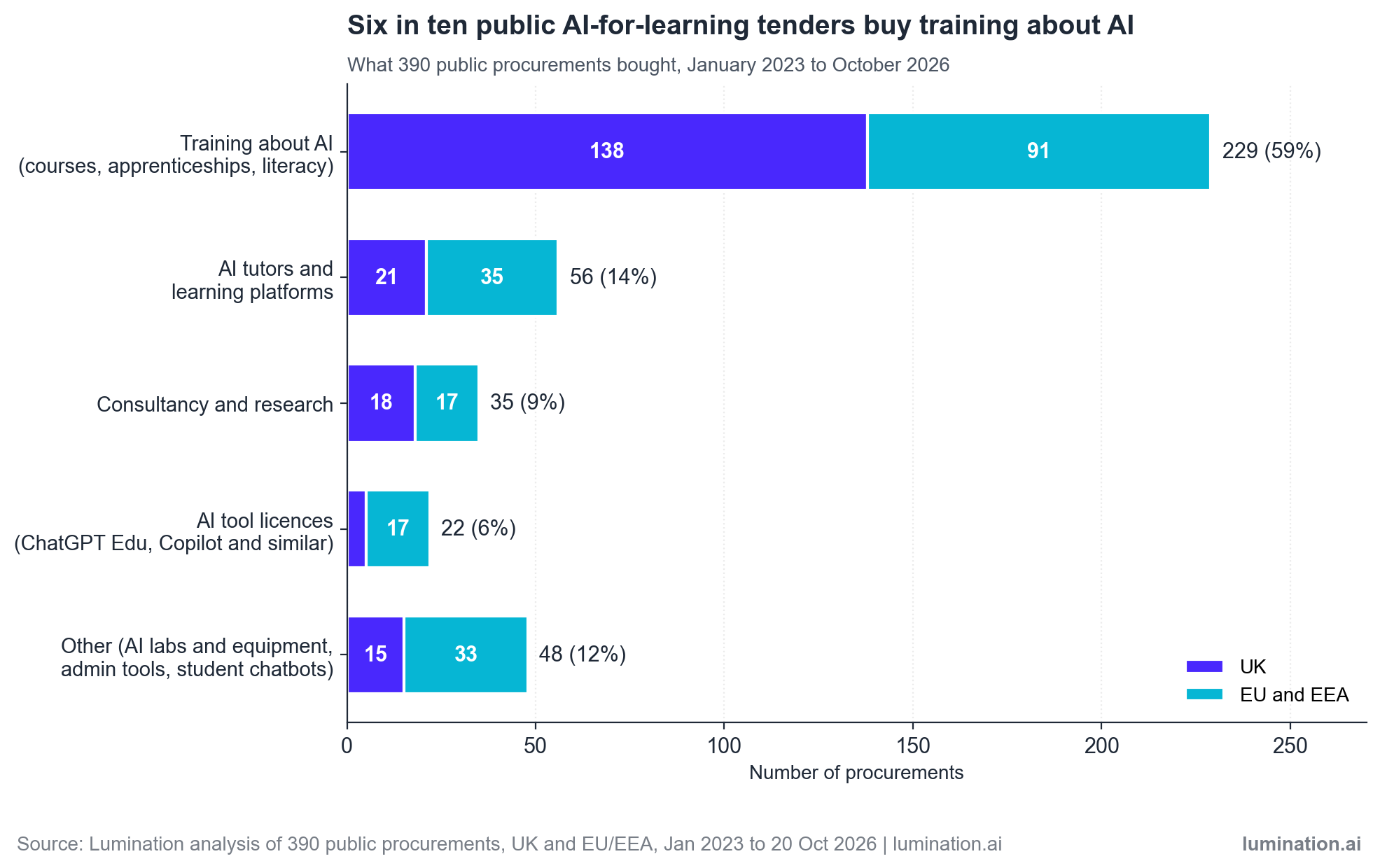
The UK leans even harder towards training, with 138 of its 197 procurements. Three kinds of purchase make up most of it.
- Apprenticeships. 47 are AI apprenticeships, such as the degree-level Level 7 AI data specialist and the Level 4 AI and automation practitioner, paid for from the apprenticeship levy by departments, councils and NHS bodies. Cambridge Spark, QA and Multiverse won most of them.
- Skills Bootcamps. 16 are AI Skills Bootcamps for local workers and small businesses, all in 2025 and 2026, run by councils and one local enterprise partnership.
- Staff training and platforms. The rest are AI courses for civil servants, AI champions programmes and learning platforms, from DSIT’s AI Skills Boost platform to a DataCamp licence for DfE staff.
In the EU, training buyers cluster in a few countries. France leads with 29, through the OPCO sector training funds, the CNFPT (which trains local civil servants) and La Poste. Germany follows with 14, from BWI, the armed forces’ IT company, to a Hesse municipal IT centre buying “KI-Kompetenz” (AI competence) courses for public staff. Spain (10), Ireland (8) and Latvia (8) come next.
Solid with caveats. An AI model coded each notice against our written rules and a reviewer checked the unclear ones. In an audit of 105 random codes, 104 held.
3. Ministries and agencies commission new AI learning tools themselves
Only a minority of purchases commission new software, and they matter most to anyone who builds AI learning products. Ministries and agencies run them, and they work more like research and development projects than purchases.
- DSIT’s AI Tutoring Tools Pioneer Programme. After DfE market engagement in February 2026 on “curriculum-aligned AI tutoring tools” for disadvantaged pupils, DSIT awarded eight research and development contracts of £300,000 each in mid-2026. The suppliers include Eedi and Medly AI, two of the tutors whose controlled trials we reviewed in Do AI Tutors Work?, along with Pearson and ElevenLabs.
- DfE’s AI Tools for Education. The first round, at the end of 2024, funded 16 developers, including King’s College London and FFT Education, with contracts of about £50,000 to £92,000 each. A second phase followed in 2025.
- DSIT’s AI Skills Boost Hub. A contract to design, build and host the national AI skills platform.
- Crown Commercial Service. £40,000 for a generative AI “virtual human” tool that lets staff practise workplace conversations as part of HR self-service.
- CITB, the construction industry training board. Market engagement in September 2026 on AI tools to develop its training and assessment products, with a tender planned for later in the year.
- Europe. The Caisse des Dépôts teaching assistant (a 21-month research phase, then up to four years of purchase), the European Maritime Safety Agency’s generative AI tools for its academy (€1m estimated), and AI features for INGURA, the Basque government IT company’s online training platform (€650,000 estimated).
The UK notices ask for tools aligned with the national curriculum, built on evidence-based teaching approaches and designed with teachers.
Directional. This rests on named examples from the notices, and we have not counted development contracts precisely, because the line between building and buying is often blurred.
4. UK buying rises every year. Europe has levelled off
UK procurements went from 16 in 2023 to 29 in 2024, 55 in 2025 and 97 by 20 October 2026, on course for about 120 over the year. The EU went from 21 to 30 to 79, then 63 by 20 October 2026, on course for about the same as 2025.
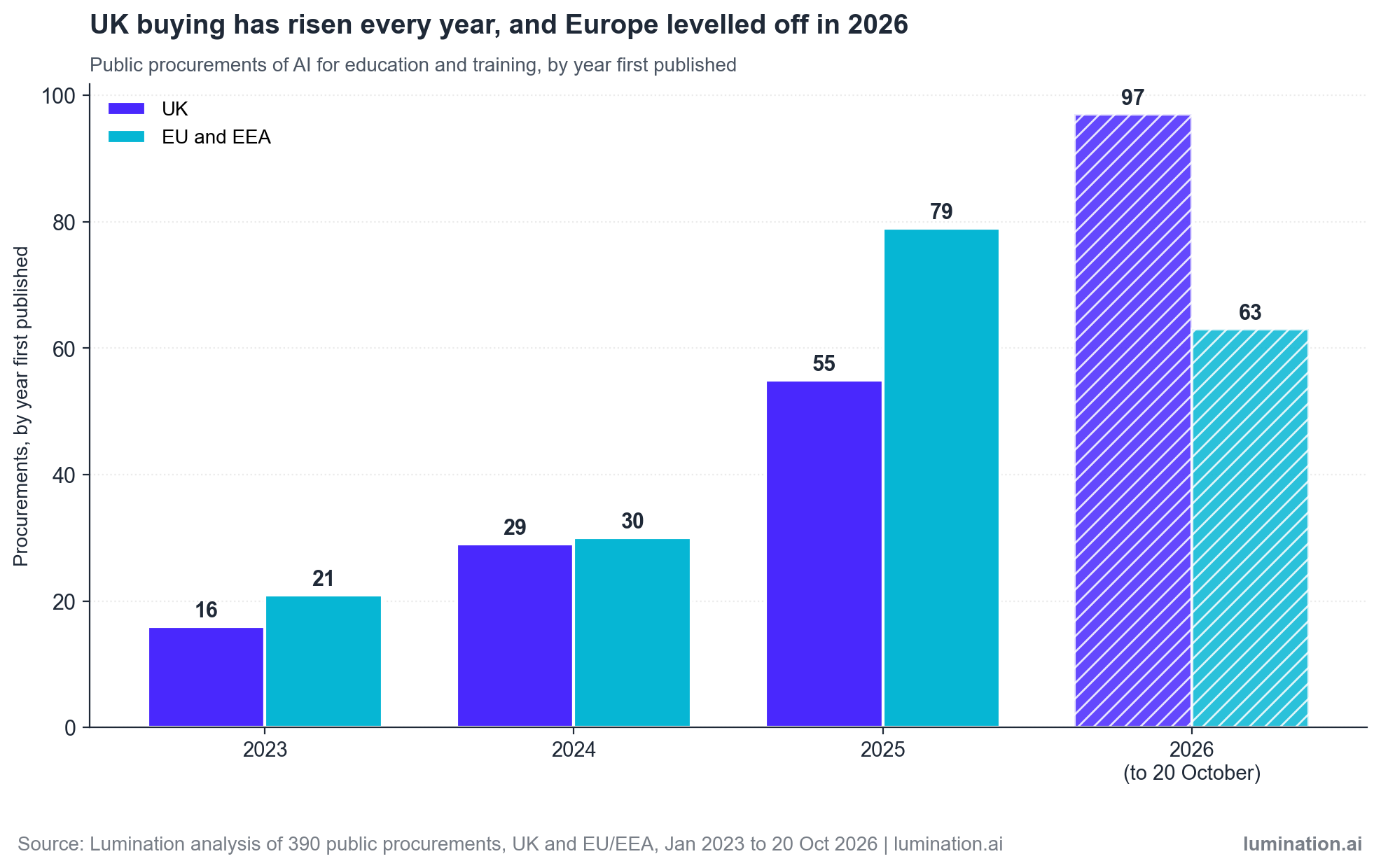
Part of the rise is AI buying in general. UK notices that mention AI rose about fivefold over the same years, and education and training stayed between 8 and 15 in every 100 of them, with no steady trend. In the EU, education and training grew faster than AI buying in 2025, from about 4 in every 100 AI notices to about 9.
Solid with caveats. It counts notices that say “AI” in plain words, and the UK’s new Procurement Act regime from February 2025 changed which notices get published, so read the size of the UK jump with care.
5. A typical contract is £90,000 in the UK and €390,000 in the EU
275 of the 390 procurements state a value. The figures below are medians for single contracts. Frameworks are shown apart, because a framework’s value is only a ceiling on what may be spent.
| Typical single contract | Middle half of contracts | Typical framework ceiling | |
|---|---|---|---|
| UK | About £90,000 | £42,000 to £226,000 | About £162,000 |
| EU and EEA | About €390,000 | €157,000 to €1.2m | About €2m |
AI training lands at about the same typical value as everything else in both regions. AI tutors and learning platforms come out at about £76,000 in the UK, from only nine contracts that state a value, and about €420,000 in the EU.
A few very large ceilings cover AI as one lot among many, such as the €57.6m (estimated) IT services framework that CSI Piemonte set up for public bodies in Piedmont. Values in other currencies, mostly Polish zloty and Romanian leu, are left out of these figures.
Directional. Almost a third of procurements state no value, stated values mix estimates and awards, and ceilings overstate spend.
6. Only one UK purchase in six goes to open tender
Of the 197 UK procurements, 33 were open tenders. 55 were direct awards, and 39 of those were contracts below the legal threshold for a regulated tender, published only after they were awarded. 24 were call-offs from existing frameworks, 16 went through dynamic purchasing systems (standing lists of approved suppliers, 14 of them for apprenticeships, such as the Crown Commercial Service’s RM6102), and 7 set up new frameworks. G-Cloud, the government’s catalogue for cloud software and services, accounts for 4, two more used other procedures, and 56 do not state a route.
The four G-Cloud purchases are the student chatbots and careers tools at Portsmouth, Nottingham Trent and Keele, and a staff AI literacy programme at the pension scheme NEST.
The EU looks different. Open procedures account for 99 of its 193 procurements and new framework agreements for 59, with only 14 direct awards.
Solid for the EU. Directional for the UK, where more than a quarter of notices give no route.
What this means if you sell, buy or build AI learning systems
If you provide AI training
The UK money sits in three places. Apprenticeships are bought as call-offs, mostly through apprenticeship purchasing systems such as RM6102. Skills Bootcamps are bought by councils. The other 75 or so UK training purchases range from a few thousand pounds to organisation-wide programmes, and many are small direct awards that only appear on a portal after they are awarded, so watching tender portals alone will miss them.
In the EU, France’s OPCOs and the CNFPT run frameworks with separate AI lots, so a specialist provider can bid for the AI lot alone.
If you run a school group or district
Check what your ministry or region already pays for before you buy. In England the DfE has paid for safe-use training, the development of AI tools for teacher assessment and a content store meant to make AI tools more accurate for schools. In Poland and Greece the hardware and apps arrive through national programmes.
This dataset covers the UK and Europe, so US districts should read it as a guide to how central buying works.
If you build AI learning products
The development contracts come through innovation competitions, research and development contracts and innovation partnerships. They ask for curriculum alignment, evidence and co-design with teachers, so a product team that can show how its tutor is grounded in curriculum content and how it was tested is better placed to win them. Our review of what the controlled studies show covers what the evidence says about AI tutor design.
We design and build AI learning systems for schools, training organisations and edtech companies. Our services and how we work show how we approach a build, from requirements to a pilot.
What this data can’t tell you
- Notices that never say AI. We matched AI terms in 24 languages. A check of 105 random AI notices outside our candidate pool found one more in scope, so a few dozen may be missing.
- Small purchases. EU-wide notices only cover purchases above EU thresholds, and single schools rarely publish anywhere.
- Spend. Values mix estimates and awards, and framework ceilings overstate spend. For programmes with several contracts, the explorer and CSV show the value from one notice.
- Motives. Notices rarely say why a buyer wants AI training or tools.
- The US. US federal notices are not covered.
How we put this together
We pulled 10,616 notices published from 1 January 2023 to 20 October 2026 from UK Contracts Finder, UK Find a Tender (all 195,768 of its releases, because its API has no keyword search) and TED, the EU’s tender journal, in all 24 official languages. 8,135 mention AI in their own text, and a rule set picked 3,527 candidates that also mention education or training or come from an education buyer.
An AI model coded each candidate blind against a written codebook for scope, buyer type, what was bought and procurement route. A lead reviewer settled 201 unclear cases and audited 105 random codes, of which 104 held. Notices for the same purchase were grouped into one procurement, which left 390 procurements (672 notices). Broad training contracts that list AI as one topic among many, such as the Cabinet Office’s 2026 civil service learning contract with KPMG and EY, were kept aside as borderline (107).
The full table (CSV) has every procurement with its official notice links, and the explorer lets you filter and search it.
Twelve procurements that show the market
| First published | Buyer | Country | What was bought | Value | Route |
|---|---|---|---|---|---|
| Jan 2024 | Caisse des Dépôts | France | AI teaching assistant (French, maths, modern languages), pupils aged about 9 to 11 | €13.3m estimated | Innovation partnership |
| Sep 2024 | Department for Education | UK | AI Tools for Education, generative AI tools for teacher assessment (16 contracts in round 1) | About £50,000 to £92,000 each | Innovation competition with Innovate UK |
| Oct 2024 | Crown Commercial Service | UK | AI “virtual human” tool for staff conversation practice | £40,000 awarded | Not stated |
| Mar 2025 | Ministry of Education programme office | Greece | Digital school apps with AI tools and adaptive content | €57.6m awarded | Open tender |
| Aug 2025 | NASK for the Ministry of Digital Affairs | Poland | 12,000 AI lab kits for schools | Framework, six suppliers | New framework |
| Dec 2025 | University of Kent | UK | Enterprise generative AI platform for staff and students | £3.3m awarded | Restricted or negotiated |
| Feb 2026 | DfE, then DSIT | UK | AI Tutoring Tools Pioneer Programme, eight R&D contracts | £2.4m awarded in total | Research and development exemption |
| Apr 2026 | European Maritime Safety Agency | Portugal (agency seat) | Generative AI tools for the EMSA Academy | €1m estimated | New framework |
| May 2026 | CNFPT | France | Digital tools and AI training for local civil servants | €2m estimated | New framework |
| Jun 2026 | DSIT | UK | AI Skills Boost Hub platform | £900,000 awarded in Oct 2026 | Open tender |
| Aug 2026 | Jisc | UK | Sector evaluation of ChatGPT Edu and OpenAI tools | $7.56m awarded | Direct award |
| Oct 2026 | Somerset Council | UK | Generative AI Skills Bootcamp delivery | £74,000 awarded | Direct award |
The Bottom Line
Public money for AI in education and training is mostly spent by ministries, councils and agencies, and mostly on teaching people to use AI. Schools rarely buy directly, AI tutors are a minority of purchases, and when a government wants a learning tool built it commissions the development itself. In the UK the market grows every year and runs on small contracts, many of them awarded directly.
Use the explorer to find the buyers and purchases closest to your own.
Buying or building an AI learning system? Tell us what you need, or write to [email protected].
FAQ
Who buys AI for schools in the UK?
Mostly the Department for Education, sometimes with DSIT. It funded generative AI tools for teacher assessment, a content store to make AI tools more accurate for schools, safe-use training for teachers and leaders, and the AI Tutoring Tools programme for disadvantaged pupils. Individual schools and trusts almost never appear in public tender notices, probably because most of their purchases are too small to need one.
How much do public AI training contracts cost?
In the UK a typical single contract for AI training is about £90,000, and half of all UK single contracts in this dataset fall between about £42,000 and £226,000. In the EU a typical AI training contract is about €395,000. A call-off for one or two apprentices can be under £20,000, while framework ceilings run into the millions.
What is the AI Tutoring Tools programme?
A UK government programme to develop curriculum-aligned AI tutoring tools for disadvantaged pupils, co-designed with teachers. The DfE consulted the market in February 2026, and DSIT then awarded eight research and development contracts of £300,000 each (£2.4m in total), to suppliers including Eedi, Medly AI, Pearson and ElevenLabs.
Do governments buy AI tutors?
Some do, but AI tutors are a minority. AI tutors and learning platforms are 56 of the 390 procurements (14%). Central government ran 15 of them, universities 13 and other public bodies such as Jisc and EU agencies 11, with the rest spread across health bodies, councils and colleges.
Is G-Cloud used to buy AI for education?
Rarely. Only four of 197 UK procurements in this dataset went through G-Cloud, all of them student chatbots, careers tools or staff AI training. Most UK purchases were direct awards, framework call-offs, open tenders or apprenticeship purchasing systems.
Where can I find AI in education tenders?
In the UK, on Contracts Finder and Find a Tender. In the EU, on TED, which only carries purchases above EU thresholds. Our explorer lists all 390 procurements from January 2023 to 20 October 2026 with links to each official notice, and a CSV you can download.